Identity by Default: The Problem Worth Solving
Explore my tools: agents-skills-plugins
Want to experience zero-knowledge proofs firsthand?
I built an interactive demo that shows how commit-reveal schemes work. Play Rock-Paper-Scissors against a server where neither side can cheat, and watch the cryptographic verification happen in real time.
Try the ZKP Demo →
The Lazy Assumption
Modern systems are built around a lazy assumption: every service must know who you are.
Banking. Healthcare. Education. Even curiosity itself.
Want to learn something about your own body? First, identify yourself.
This isn't medicine. It's bureaucracy disguised as care.
The name is not required for accuracy. It's required for control.
Once identity is attached, the data becomes:
- Monetizable
- Subpoena-able
- Breachable
- Permanent in ways you can never undo
A DNA database without names is a scientific resource. A DNA database with names is a liability factory.
Proof Without Exposure
Here's where zero-knowledge proofs quietly change everything.
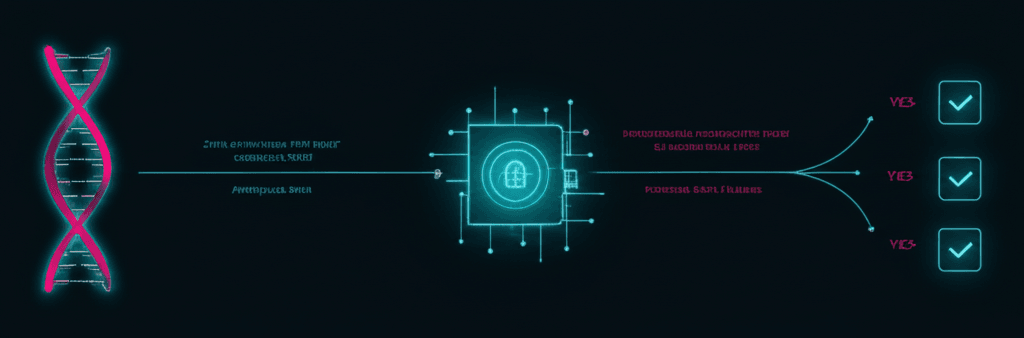
A zero-knowledge proof lets you prove something is true without revealing why it's true, and without revealing who you are.
Applied to medical data, the flow looks radically different:
- You submit DNA anonymously.
- The lab produces a cryptographic commitment to your genome.
- You receive a key, not an account.
From that point forward, you can generate proofs like:
- I do not carry mutation X.
- I am compatible with drug Y.
- I qualify for trial Z.
The verifier learns the answer. Nothing else.
No genome. No identity. No centralized database full of irreversible harm waiting to happen.
See It For Yourself
This might sound abstract. Let me make it concrete.
I built a Rock-Paper-Scissors game that demonstrates the core mechanism: commit-reveal. Here's how it works:
- You choose rock, paper, or scissors
- Your choice gets hashed with a random nonce (your commitment)
- The server makes its choice and commitment simultaneously
- Both commitments are locked. Neither side can change.
- Both sides reveal their choice + nonce
- Anyone can verify: hash(choice + nonce) must equal the original commitment
If the hashes don't match, someone cheated. But they always match, because neither side can cheat once committed.
This is the foundation. The same principle scales to proving you don't carry a genetic mutation, proving you're over 21, or proving you qualify for a clinical trial. The math gets more sophisticated (zk-SNARKs, zk-STARKs), but the core idea remains: commit to truth, prove without revealing.
This Is Not About Hiding
This is the part people get wrong.
Zero-knowledge systems are not about secrecy for secrecy's sake. They're about correct boundaries.
You are not hiding medical facts from yourself. You are refusing to expose everything to get one answer.
Just like Bitcoin didn't hide transactions but removed the need for trusted intermediaries, ZKPs don't hide truth. They remove unnecessary trust.
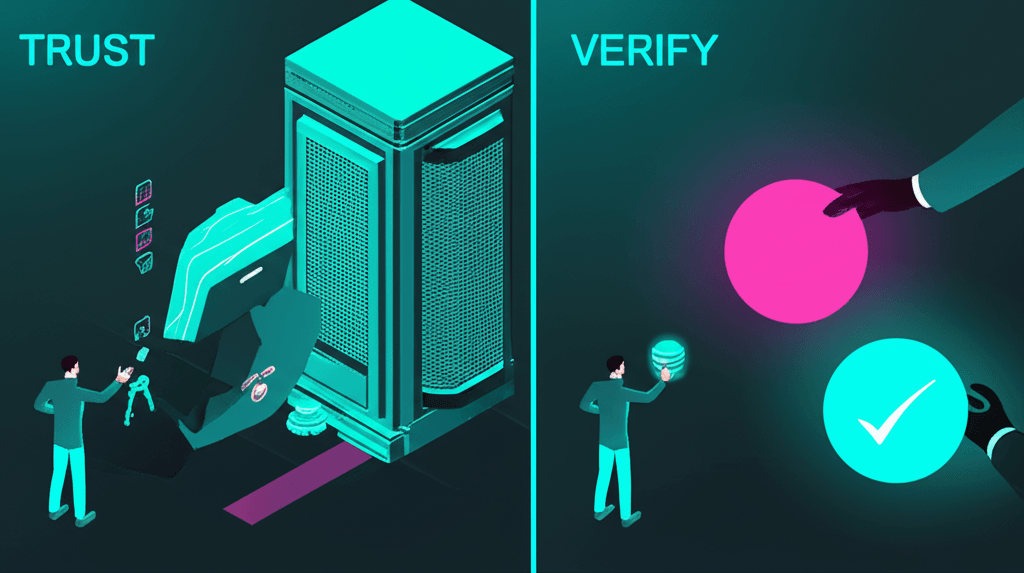
They replace "trust us with your data" with "verify the claim."
That's not paranoia. That's engineering.
Why Names Became Mandatory
If names aren't required, why do systems insist on them?
Because identity is useful to institutions.
It enables:
- Long-term tracking
- Cross-service correlation
- Future policy enforcement
- Business models that depend on resale
In other words, the name isn't for the service you're receiving today. It's for the leverage someone might want tomorrow.
That's the quiet part no one says out loud.
The Future That Should Have Been Obvious
Imagine a world where healthcare works like this:
- You prove eligibility, not identity.
- You prove compatibility, not history.
- You prove compliance, not submission.
Hospitals don't store massive identity-linked datasets. Labs don't become surveillance nodes. Breaches don't ruin lives forever.
The technology to do this already exists. What's missing is the will to stop over-collecting.
The Real Question
So the question isn't "can we do anonymous DNA testing?"
We can.
The real question is: Why did we ever accept systems that demanded our names when they didn't need them?
Once you see that, you can't unsee it. And zero-knowledge proofs stop being "crypto math" and start looking like something much more basic:
A correction.
A return to proving facts instead of surrendering people.
That's the problem worth solving.